
Shape Shifter: A Reflection On Becoming
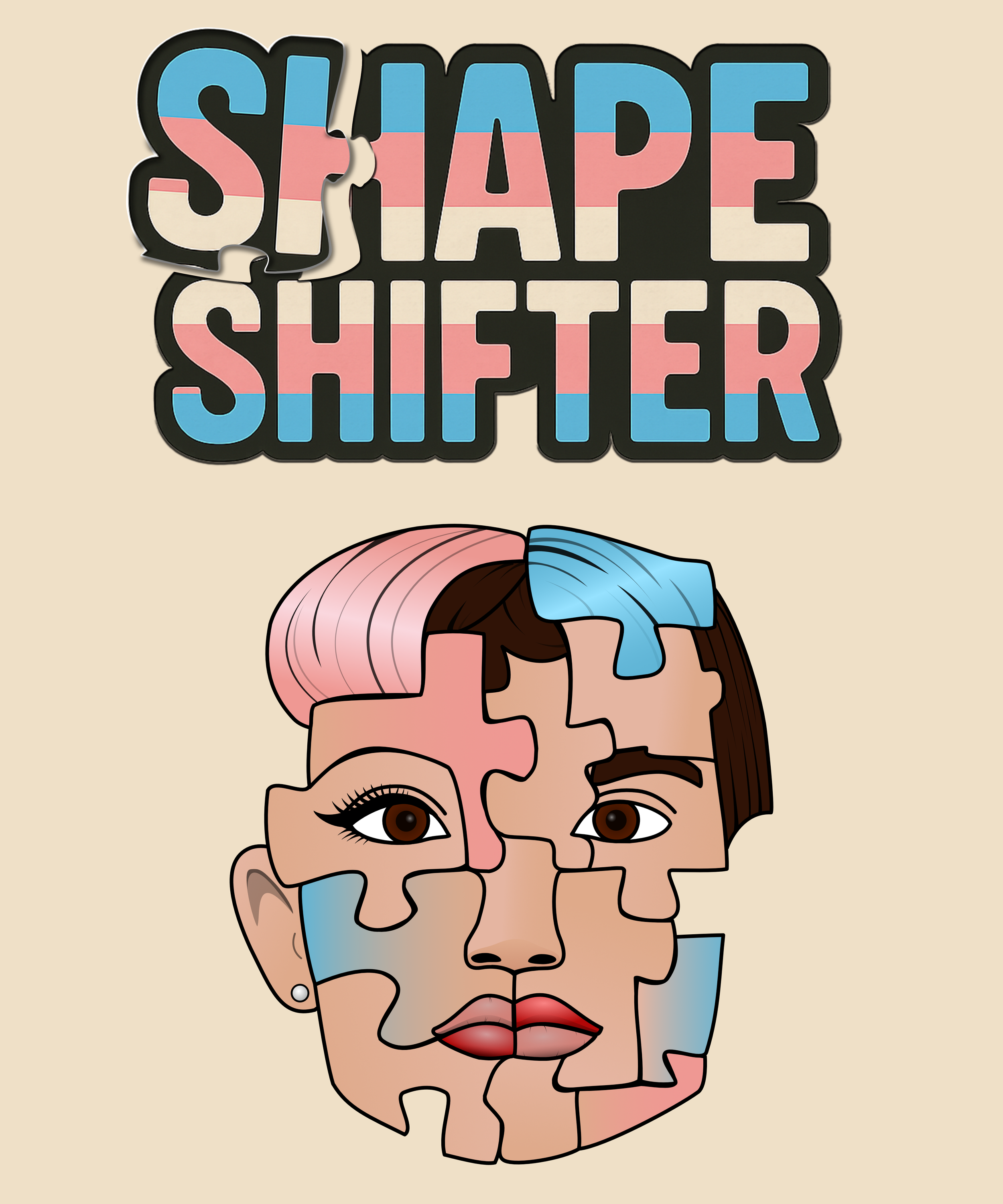
I've been staring at this design for a week now, the one I call "Shape Shifter." It's a human face made entirely of puzzle pieces, each one holding a different feature, a wing tipped eye, lips painted bold, an ear, a brow. Some pieces fit together. Others hover at the edges, not quite connecting. The outer perimeter remains incomplete, deliberately so. Above it all, the title itself is fractured, the letters separated like they're still searching for their place.
People keep asking me what it means. The truth is, I created it because I'm tired of explaining myself in words. I'm forty years old. I'm a mother. I'm queer. I'm trans. Every single day of my life, I'm assembling and reassembling the face I show the world, trying to figure out which pieces are safe to display and which ones need to stay hidden in the box.
That's what "Shape Shifter" is really about. It's about survival. It's about the exhausting dance we do when we can't afford to be ourselves.
The Art of Code Switching
There's this term that gets thrown around a lot in social justice circles: code switching. It refers to the way people alter their behavior, speech, or appearance depending on their environment. For many of us in marginalized communities, it's not a choice…it's a survival mechanism. I learned to code switch before I even had the language to name what I was doing.
When I walk into a public restroom, I run through a mental checklist. Voice pitch. Posture. Eye contact. How I'm dressed that day. Whether I remembered to cover the stubble I can't quite afford to have lasered away yet. I calculate risk in microseconds. Will someone clock me? Will they say something? Will they do more than say something? These aren't paranoid fantasies. These are questions based on lived experience, on news reports, on the stories shared in hushed tones at support group meetings.
The puzzle pieces with shades of pink know how to navigate certain spaces. The pieces with shades of blue know how to navigate others. I'm constantly swapping them out, reading the room, shapeshifting into whatever version feels safest in the moment. It's exhausting. It's also necessary. According to the 2024 U.S. Transgender Survey, nearly half of transgender people reported being verbally harassed in public spaces within the past year because of their gender identity. More than one in ten reported being physically attacked. These aren't abstract statistics to me. They're Tuesday afternoon at the grocery store. They're every time I need to use a public facility. They're the reason I sometimes choose not to leave my house at all.
So I shift. I adjust. I balance the shapes that let me move through the world with the least amount of friction, the smallest target on my back, but also allow me to breathe. Here's the thing nobody tells you about constant shapeshifting…you start to forget what your actual shape is.
The Weight of Definitions
One of the puzzle pieces in my design has heavy eye makeup. Another has a traditionally "masculine" brow. They sit side by side, neither one canceling out the other, both part of the same incomplete face. I did that on purpose because I'm so damn tired of the binary.
"What makes a woman?" "What makes a man?" These questions haunt me, haunt all of us, especially in the middle of the night when I can't sleep because I'm scrolling through news articles about another piece of anti-trans legislation. The lawmakers writing these bills seem to have very clear answers. A woman is XX chromosomes. A woman is a uterus. A woman is whatever they've decided she is, and anything outside that narrow definition is a threat that must be legislated away.
But then I think about the women I know. Cis-women who can't have children, women with hormonal imbalances, women who bleach their facial hair, women who are tall or broad-shouldered or deep-voiced, women who never wear makeup, women who do. Are they not women because they don't fit every stereotype? Of course not. So why is the measure different for me? I spent years trying to perform femininity "correctly." I watched makeup tutorials until my eyes crossed. I studied the way women moved, spoke, gestured. I practiced a different laugh. I bought clothes that hurt. I apologized for taking up space. Still, it never felt like enough. There was always another box to check, another standard to meet, another way I was failing at being what others expected a woman to be.
The puzzle pieces in "Shape Shifter" don't match conventional expectations, and they're not meant to. The lips sectioned off to have lipstick and no lipstick isn't a mistake or a compromise. It's the reality of gender expression for many of us. It's the acknowledgment that these categories we've been handed are far too small to contain the full spectrum of human experience. But the world demands we squeeze ourselves into them anyway, and suffer the cognitive dissonance of that requirement. Being torn between authenticity and safety, between self-expression and survival is part of what the incomplete face represents.
The Ongoing Process
Here's what I wish someone had told me before I came out: being transgender isn't a journey with a destination. There's no finish line where you finally become yourself and then get to rest. It's an ongoing process of discovery, adjustment, and rediscovery. It's rebuilding yourself piece by piece, and sometimes having to start over when pieces don't fit the way you thought they would. It’s the incomplete puzzle in my design. I'm not finished. I might never be finished. I'm trying to make peace with that.
I came out in my thirties, after decades of trying to make the wrong puzzle pieces fit. I was married. I had a good job. Close friends. I had built an entire life around being someone I wasn't. Coming out meant detonating that life. It meant watching relationships dissolve. It meant explaining to my family why their child was changing, knowing they would never fully understand. It meant starting hormone therapy and feeling my body finally begin to align with my internal sense of self while simultaneously grieving everything I was losing.
People think transition is about physical changes, and yes, there's that. But the harder work is internal. It's unlearning decades of shame. It's building new neural pathways around self-worth. It's figuring out which parts of yourself were genuine and which were just survival mechanisms you mistook for personality traits. Some days I feel like I'm making progress. I look in the mirror and slowly begin to recognize the person looking back. Other days I feel like I'm assembling myself from scratch all over again, trying to remember which pieces go where. The shapeshifting isn't just external anymore. It's internal too. That might be the most exhausting part of all.
The Cost of Visibility
The statistics on transgender mental health are devastating, and they're getting worse. According to The Trevor Project's 2023 National Survey, 41% of transgender and nonbinary youth seriously considered suicide in the past year. Let that sink in. Nearly half of trans kids thought about ending their lives. It's not because being transgender is inherently traumatic. It's because of how we're treated. It's because of the legislation that frames our existence as dangerous. It's because of the rhetoric that paints us as predators, threats, and moral panics. It's because kids are watching adults debate whether they deserve basic rights, healthcare, and dignity.
When I was working on "Shape Shifter," I read about yet another state proposing a ban on gender-affirming care for minors. Then another proposing restrictions on bathroom access. Then another trying to make it illegal for teachers to use a student's chosen pronouns. Each new bill felt like another puzzle piece being forcibly removed from the design. Not just from the abstract design, but from trans people's ability to exist safely in public life. The American Psychological Association has documented the direct correlation between this legislative environment and increased mental health crises in transgender communities. When you're constantly told you're a problem to be solved rather than a person to be respected, it takes a toll. When you have to spend mental energy calculating risk just to exist in public spaces, it accumulates. When you watch your government debate your right to healthcare, to education, to use a bathroom, it grinds you down, piece by piece.
I think about this when I look at my own kid. I think about the world they're inheriting. I think about what it means to be a trans parent trying to model resilience when I'm barely holding myself together some days. On occasion I find myself breaking into tears while holding them. I think about the fact that my visibility, which I am fighting so hard for, now feels increasingly dangerous. That's what the missing pieces represent too. The parts of ourselves we can't show because it's not safe. The aspects of our identity we have to keep hidden to protect ourselves, our families, our livelihoods. We're incomplete not by choice but by necessity.
The Future
I created "Shape Shifter" because I needed to externalize what's been living in my head for years. I needed to show what it feels like to be constantly assembling and reassembling yourself. To be multiple things at once; feminine, masculine, somewhere in the middle, or none of the above. Visible and hidden, complete and unfinished. To be exhausted from the performance but unable to stop performing because the alternative is too dangerous. The design isn't beautiful in a conventional sense. It's not meant to be. It's fractured and incomplete and full of contradictions. That's the point. That's the reality for so many of us.
But here's the thing I keep coming back to: even incomplete, even fractured, it's still a face. It's still a person. The puzzle pieces might not match society's expectations, they might not form a conventional picture, but they're mine. They're me. I'm still here, still shifting, still surviving, still trying to find the pieces that fit. I'm forty years old. I'm a mother. I'm queer. I'm trans. I'm tired of apologizing for being all those things at once. I'm tired of hiding pieces of myself to make others comfortable. I'm tired of the constant calculation of risk. But, I'm also still here. Still creating. Still claiming space. "Shape Shifter" is my way of saying, "‘this is what survival looks like for me’. This is what it costs to exist in a world that doesn't have space for me. This is the ongoing work of becoming myself when myself doesn't fit the predetermined categories. This is what it means to be incomplete but still whole, still valid, still deserving of dignity and safety and the right to simply exist.
The puzzle isn't finished. Maybe it never will be. Every piece matters, even the ones that don't match, even the ones that society says shouldn't be there. Especially those ones. I made "Shape Shifter" because I needed to see my own reflection, fractured and incomplete as it is. Because I needed to remind myself that shapeshifting for survival doesn't make me less real. I needed something tangible to point to when people ask why I seem so exhausted, why I can't just "pick one" and stick with it, why being myself is so complicated. I’m just trying to assemble myself in a world that keeps insisting I use the wrong pieces.
If this post inspired you and want to support me as an independent artist, consider purchasing the t-shirt to show your support.
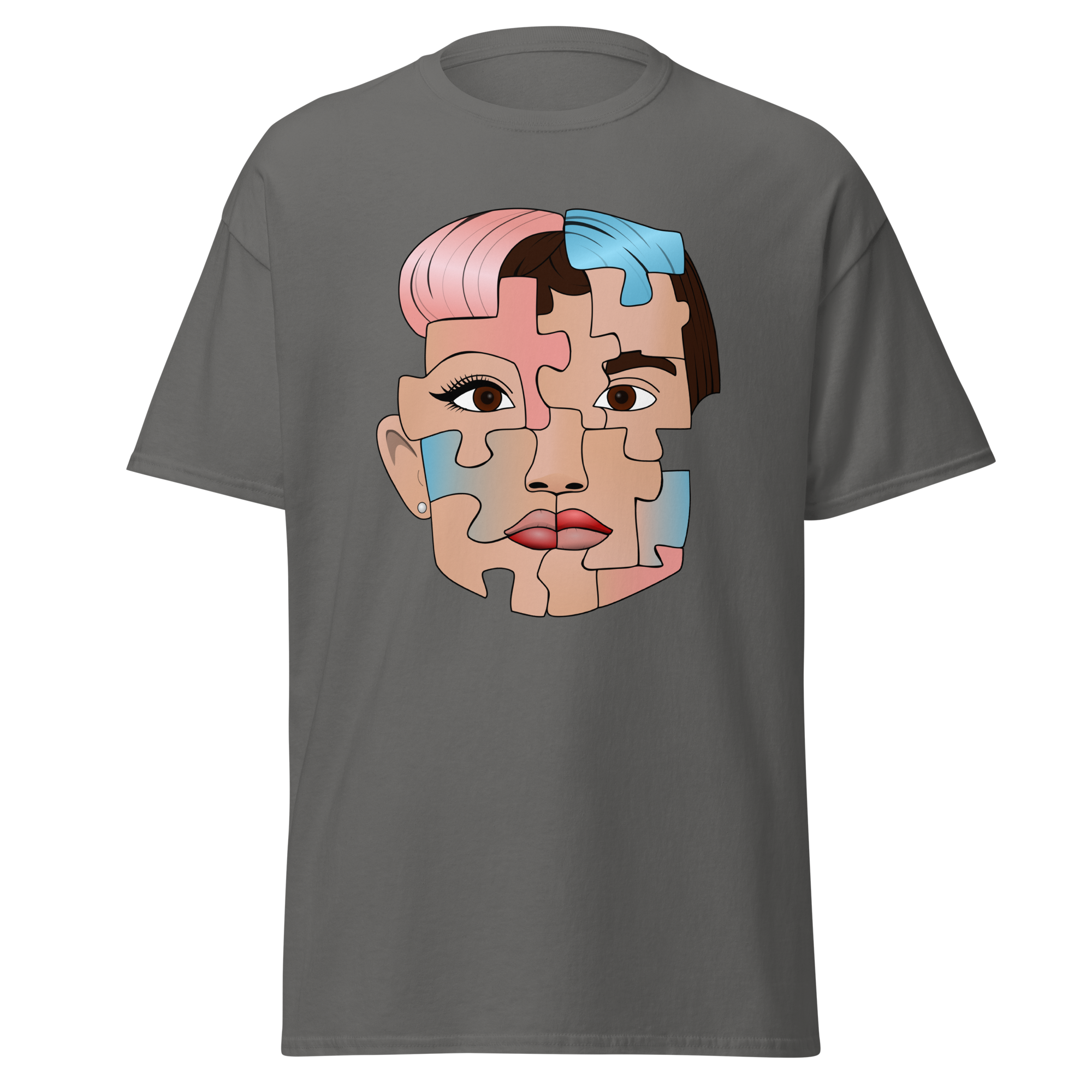
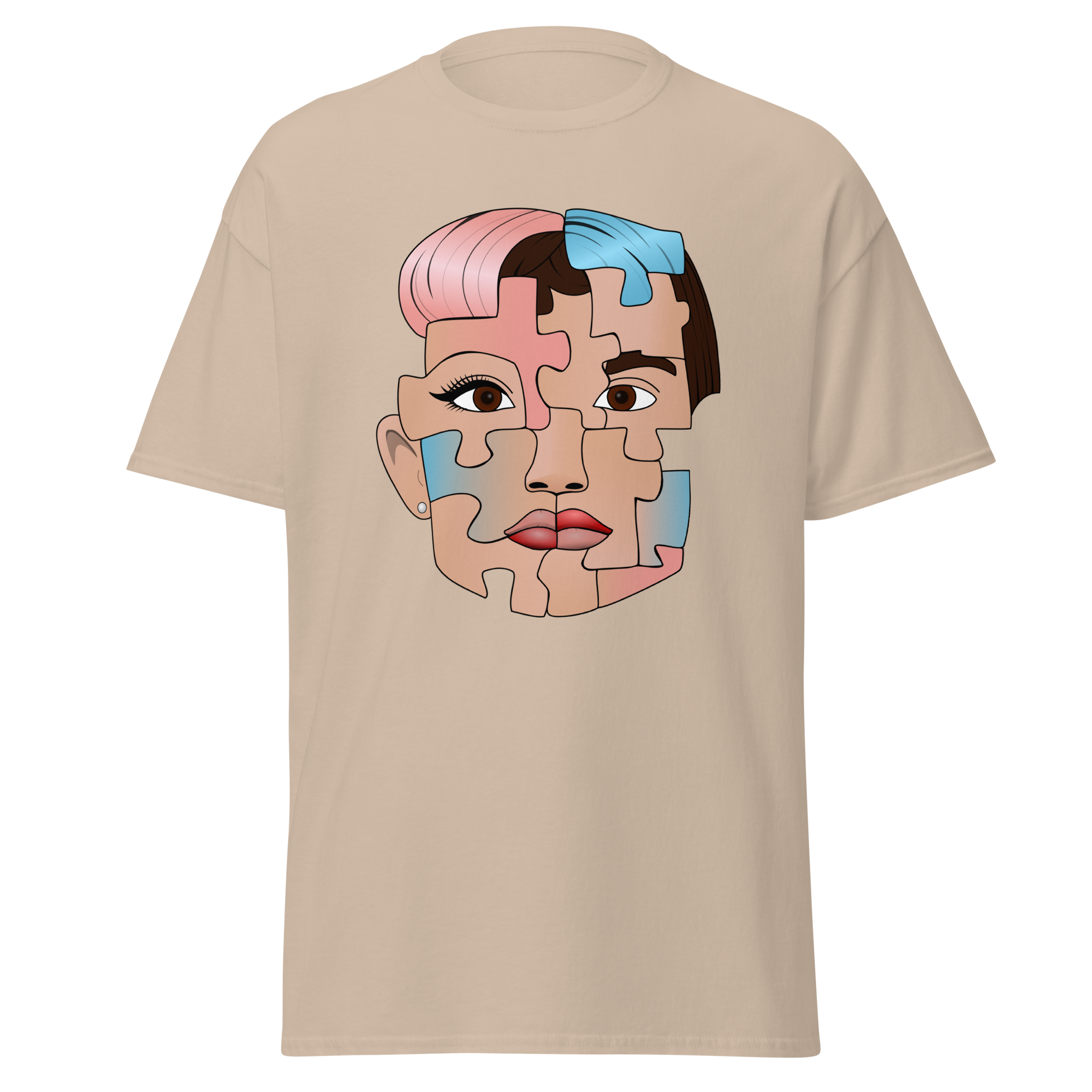
DETAILS
Unisex
100% cotton
Fabric weight: 5.0–5.3 oz/yd² (170–180 g/m²)
Pre-shrunk jersey knit
Open-end yarn
Tubular construction
Taped neck and shoulders
Double seam at sleeves and bottom hem
Tear-away tag
SHIPPING + RETURNS
Orders are typically orders within 3 days from when the order is placed. Standard shipping times depend on carrier.
Please review our size guide and return policy before making a purchase.
Want something more stationary? Check out the poster on my Etsy shop